Reframing Eating:
Drivers, Influences, and Transitions.
A Push–Pull Framework for
Systematic Dietary Shift
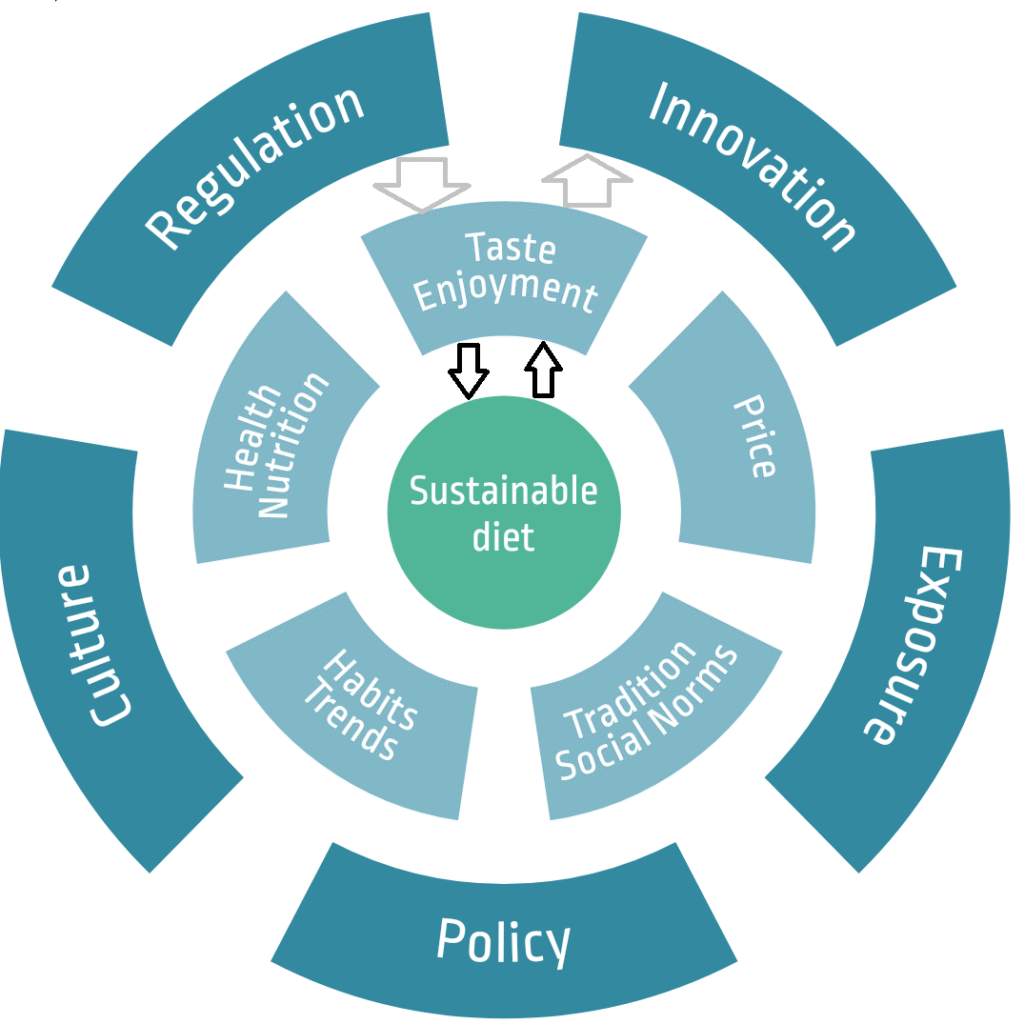
ReDIET — Reframing Eating: Drivers, Influences, and Transitions — identifies push and pull factors influencing individual food choices, while recognizing that these decisions are ultimately shaped by broader systemic forces. Everyday food choices are made within the structures provided by the food system — including producers, distributors, and retailers — all of which operate according to social norms and procedures linked to national culture, workplaces, educational environments, and personal networks of family and friends. The ReDIET framework illustrates this dynamic interaction between individuals and their environment through two concentric rings. The factors noted in the rings are the push and pull factors we focus on. Push and pull factors are directed towards the individuals making the food choices. Any actor in the food system can initiate these factors, including the government, other individuals, and companies. What distinguishes push and pull factors from other influences is that they are intentional towards altering food choices. The inner ring highlights the most important — though not exhaustive — factors influencing consumer dietary behavior. We will first introduce the inner factors.
One of the primary barriers to adopting meat substitutes is price (Steenhuis et al., 2011; Newton et al., 2024; Valli et al., 2023; Kemper et al., 2023; Behavioural Insights Team, 2020). Many consumers are unwilling to pay more for products that are not their primary preference (Carlsson et al, 2022). Although in several countries the price of meat substitutes approaches that of conventional meat (Proveg, 2022; Proveg, 2023; Proveg, 2023), studies indicate that further price reductions may still be necessary to encourage widespread adoption (Carlsson et al, 2022; Kemper et al., 2023). Taste is another major hurdle (Szenderak et al., 2022; Carlsson et al, 2022; Valli et al., 2023). Despite significant improvements and diversification in available options, consumer acceptance remains limited. Beyond price and taste, health considerations also strongly influence food choices (van Bussel et al., 2022; Marty et al., 2022; Van Loo et al., 2017). Sustainable diets are often perceived as healthier (Kenny et al., 2023), which serves as a key motivator for their adoption (Valli et al., 2023). However, meat continues to be seen by many as essential to a healthy diet (Cleland et al., 2025). Another critical barrier is resistance to change habits, often linked to not willing to try new food (e.g. food neophobia, Eckl et al., 2021; Onwezen et al., 2021; Hielkema & Lund, 2021; Onwezen & Dagevos, 2024; Siddiqui et al., 2022) and food safety concerns (van Bussel et al., 2022). However, perceived nutritional benefits can help mitigate this resistance (de Koning et al., 2020). Finally, social and cultural norms, and traditions play a crucial — yet under-researched — role in influencing dietary behavior (Onwezen, 2021; Furst et al., 2016). These norms can both support the adoption of sustainable diets (Salmivaara et al., 2021; Loken et al., 2024) and promote the reduction of meat consumption (Valli et al., 2023). When enough individuals within a social network abandon meat consumption, this collective shift can disrupt the traditional link between meat, identity, and culture, creating a spillover effect (Efferson et al., 2020; Efferson et al., 2024).
Widespread adoption of sustainable diets requires targeted policies that remove key barriers and actively make sustainable choices more attractive. The outer ring highlights important system level factors that can accelerate this shift. Innovation must expand and improve sustainable food options, particularly enhancing taste and variety (Hassoun et al., 2024; Sridhar et al. 2022), while cultural change is essential to make these options socially desirable (Szenderak et al., 2022). Where voluntary shifts stall, policy makers must step in — supporting the sustainable food sector and applying pressure to phase out unsustainable practices (Tziva et al., 2020; Moberg et al., 2021). For example, introducing a health and clean label for meat substitutes could help to guide consumers toward more sustainable choices (Aschemann-Witzel et al., 2020). Governments also play a critical role by implementing economic incentives that favor sustainable foods over conventional ones (Huangfu et al., 2024; Aiking & de Boer, 2020). Regulations, such as taxes, are proven effective measures to reduce meat consumption (Vellinga et al., 2022). Media campaigns, particularly via social media, can amplify the visibility and appeal of sustainable diets (Hundscheid et al., 2022). In parallel, workplaces and educational institutions should redesign public spaces to normalize and promote sustainable food choices (Lohmann et al., 2022).
The gray arrows between the inner and outer ring symbolize how the system level factors dynamically influence the individual-level factors. For instance, as price plays a huge role in consumer’s behaviour, an economic policy that makes sustainable food choices more affordable might positively influence people to prefer sustainable food. At the same time, as more people make such choices, they give an impulse to develop more sustainable food choices. The black arrows highlight how systematic developments impact why and to what extent people care about sustainable food choices. To stick to the example of a subsidy on sustainable food choices: as the price between meat and meat substitutes increases, people may more often switch to meat substitutes at BBQs or other celebrations which in turn change the social norms of how important meat is at these occasions. Although in the graph only one set of arrows at each level are presented, all aspects of the inner ring will affect sustainable diets, and all aspects of the outer ring will determine how the push and pull factors may impact the diet. Over time, there might be a long lasting effect of how the system level influences the individual food choices. This long lasting effect does not need to be gradual, it may well develop at a stepwise approach. Shocks to the system (e.g. approval of meat substitutes for the market, scale-up in production, improved taste) might generate huge boosts in the utility function, leading people to have higher preference for sustainable food choices over the conventional food choices. In turn, these so-called tipping points (Centola et al., 2018) stimulate opportunities for the system-level aspects (e.g. subsidies, new industries, capital inflow), creating a self-reinforcing cycle (Otto et al., 2020). At the individual level, similar dynamics are at play with crucial tipping points for increased acceptance of meat substitutes (Judge et al., 2024; Constantino et al., 2022), however, these may also backfire (Efferson et al., 2019).